Palestine viper
2,404 events · the most reported species
39.7%

דף הבית » Reptiles of Israel Data Center
דף הבית » Reptiles of Israel Data Center
The Reptiles of Israel Data Center collects, processes and makes publicly available data obtained from official sources, as part of the project’s citizen-science activity.
This page presents three datasets, one after the other: first, snake capture data in Israel for 2022–2026, based on information obtained from the Israel Nature and Parks Authority through a Freedom of Information request, and then, animal-related injury data in Israel for 2015–2022, based on information obtained from the Ministry of Health; and finally, snakebite data in animals for 2017–2026, based on data from the Koret School of Veterinary Medicine Teaching Hospital, along with a combined summary of all three datasets.
The data make it possible to examine trends over time, seasonality and the extent of encounters between people and animals in Israel. The Ministry of Health data include, among other things, snake bites, scorpion stings and spider bites — and the number of scorpion stings is significantly higher than the number of snakebites.
Data from each source are presented separately, according to the definitions, the range of years and the limitations of the information provided by the relevant body.
Every year there are many encounters between people and snakes in Israel — in yards, gardens, storerooms, farmland and areas close to where people live.
As part of the Reptiles of Israel project, 6,056 reported snake capture events were analyzed from a database obtained from the Israel Nature and Parks Authority through a Freedom of Information request.
The data show which species stand out in capture events, how the number of reports changes across the months of the year and between years, and what differences exist between regions and communities in Israel.
This page brings the findings together through numerical data, regional comparisons and interactive maps, giving a broad picture of the capture events reported in Israel in 2022–2026.
The data were obtained through a Freedom of Information request to the Israel Nature and Parks Authority. The source file includes the date of the event, the geographic coordinates (WGS84), and the taxon’s Hebrew and scientific names.
The information was processed and analyzed by the Reptiles of Israel project, keeping the source records intact, without filling in missing data or creating events that did not appear in the database.
For year-to-year comparisons, the focus is on 2023–2025, which include 4,850 events — 80.1% of the entire database. The 2022 and 2026 data are partial and are therefore not used for direct comparison with full years.
It is important to read the data in the right context: these are reported capture events, not a population survey or a distribution map of snakes in the wild. The coordinates represent the location recorded in the original report, and a large number of events in a given area does not necessarily indicate a higher density of snakes.
From the capture-event database
Of the 6,056 records in the database, just five species account for the vast majority of reports.
Together, the five species account for 5,068 events of the 6,056 records in the database.
2,404 capture events · the most reported species
The data highlight how concentrated reported capture events are in a small number of species. However, a high share in the database does not necessarily mean a species is more common in the wild: species that frequently meet people and enter yards, buildings and populated areas may appear more often in capture reports.
From the capture-event database
Of the 6,056 records in the database, just five species account for the vast majority of reports.
2,404 events · the most reported species
1,361 events
652 events
376 events
275 events
legless lizard988 events combined
Together, the five species account for 5,068 events of the 6,056 records in the database.
A high share in the database does not necessarily mean a species is more common in the wild: species that frequently meet people and enter yards, buildings and populated areas may appear more often in capture reports.
From the capture-event database
The database records 2,533 capture events of venomous snakes — 41.8% of all 6,056 records.
of venomous-species capture events are of the Palestine viper — 2,404 of 2,533.
2,404 events · 94.9% of venomous-species capture events
59 events
40 events
13 events
8 events
5 events
3 events
one record · outlier, requires verification
The file contains reports classified under eight venomous species. One record is labeled as a Lebanon viper (0.02%), but its coordinates fall outside the species’ known range, so it is shown as an outlier that requires verification and not as evidence of the Lebanon viper’s presence in the area. The data show that, in reported capture events, the Palestine viper stands out by a very wide margin compared with the other venomous species.
From the capture-event database
The database records 2,533 capture events of venomous snakes — 41.8% of all 6,056 records.
of venomous-species capture events are of the Palestine viper — 2,404 of 2,533.
2,404 capture events · 94.9% of venomous-species capture events
The file contains reports classified under eight venomous species. One record is labeled as a Lebanon viper (0.02%), but its coordinates fall outside the species’ known range, so it is shown as an outlier that requires verification and not as evidence of the Lebanon viper’s presence in the area. The data show that, in reported capture events, the Palestine viper stands out by a very wide margin compared with the other venomous species.
Reported capture events are not spread evenly across the year: a sharp peak in spring and early summer, a second wave in autumn and a low in winter.
December – February
320 events
The quietest months in the database
May – June · peak of the year
1,983 events
Almost a third of all capture events in just two months
September – October
1,242 events
Another high level of reports after the summer
The seasonal pattern points to a sharp rise in capture events in spring and early summer, alongside another high level in autumn. However, this is a pattern of events reported in the database, not a direct measure of the size of snake populations or of the number of snakes active in the wild.
Reported capture events are not spread evenly across the year. May is the most prominent month in the database, with 1,068 events — 17.6% of all records,
followed by June with 915 events — 15.1%. Together, the two months account for 1,983 events — 32.7% of all reported capture events.
Reports also remain active in the autumn: 655 events were recorded in September — 10.8% of the database,
and 587 events in October — 9.7%.
In contrast, the lowest numbers were recorded in the winter months: 87 events in December — 1.4%, 96 in January — 1.6%, and 137 in February — 2.3%.
The seasonal pattern points to a sharp rise in capture events in spring and early summer, alongside another high level in the autumn. However, this is a pattern of events reported in the database, not a direct measure of the size of snake populations or of the number of snakes active in the wild.
Analysis of reported capture events obtained through a Freedom of Information request
Five species account for 83.7% of all capture events.
2022 and 2026 are partial and cannot be compared directly with full years.
Between 2023 and 2025, reported capture events grew by 213. The change does not necessarily indicate a change in the number of snakes in the wild.
May and June together account for 1,983 events — 32.7% of all records.
2,533 capture events of venomous snakes out of 6,056 records.
How to read the data correctly
94.9% of venomous captures are Palestine vipers — the other venomous species appeared in very low numbers.
These are reported capture events near people, not a population survey or a distribution map of snakes in the wild.
For the comparison, reported capture events from 2023–2025 were divided into three regions: Gedera to Eilat, Gedera to Hadera, and Hadera to the northern border.
Each of the three charts shows the 50 communities with the most reported capture events. Each row shows the total number of events and the mix of species recorded in that community. The species legend is tailored to each region, so that species of regional importance are not lost in the “other species” category.
The comparison shows how the mix of capture events changes between regions and between communities. Geographic assignment was carried out according to the method described in the methodology section above.
Important: the charts describe reported capture events near people and are not a distribution map or a survey of wild populations.
In this region, 2,041 capture events were recorded in 2023–2025. Of these, 1,853 events were assigned to an identified community and 188 points remained without a verified community assignment.
The chart shows the region’s top 50 communities, where a combined 1,290 capture events were recorded. Each row shows the total number of events and the mix of species reported in that community.
Click the image to open and enlarge it.
Broken down by the top 50 cities and communities. Each row shows the total number of events and the mix of species reported in that community. The chart describes reported capture events near people and is not a distribution map or a survey of wild populations.
Source: Israel Nature and Parks Authority file, 2023–2025. Each event is counted once according to the coordinates and species in the file. A community is shown only when the coordinates fall within the city or community boundary.
In this region, 1,694 capture events were recorded in 2023–2025. Of these, 1,524 events were assigned to an identified community and 170 points remained without a verified community assignment.
The chart shows the region’s top 50 communities, where a combined 1,133 capture events were recorded. Each row shows the total number of events and the mix of species reported in that community.
Click the image to open and enlarge it.
Broken down by the top 50 cities and communities. Each row shows the total number of events and the mix of species reported in that community. The chart describes reported capture events near people and is not a distribution map or a survey of wild populations.
Source: Israel Nature and Parks Authority file, 2023–2025. Each event is counted once according to the coordinates and species in the file. A community is shown only when the coordinates fall within the city or community boundary.
In this region, 1,115 capture events were recorded in 2023–2025. Of these, 936 events were assigned to an identified community and 179 points remained without a verified community assignment.
The chart shows the region’s top 50 communities, where a combined 719 capture events were recorded. Species typical of desert areas also stand out in this region, so the species legend has been adapted to the mix of reports in the south.
Click the image to open and enlarge it.
Broken down by the top 50 cities and communities. Each row shows the total number of events and the mix of species reported in that community. The chart describes reported capture events near people and is not a distribution map or a survey of wild populations. Species typical of desert areas also stand out in this region, so the species legend has been adapted to the mix of reports in the south.
Source: Israel Nature and Parks Authority file, 2023–2025. Each event is counted once according to the coordinates and species in the file. A community is shown only when the coordinates fall within the city or community boundary.
The three interactive maps show the capture events recorded in the three full years in the database: 1,499 events in 2023, 1,639 in 2024 and 1,712 in 2025. Together, that is 4,850 events — 80.1% of the 6,056 records examined.
Each point on the map represents a reported capture event, according to the geographic coordinates recorded in the source file. The maps let you zoom in, move between regions and explore how events are spread and which species were recorded at each point.
Between 2023 and 2025, the number of reported capture events grew by 213 events — an increase of 14.2%. However, the change in the number of points between years does not necessarily indicate a change in the number of snakes in the wild, and may also be affected by the extent of reporting and by the number of capture events recorded in the system.
Important: the maps are not distribution maps of snakes in Israel. They show only the locations of the capture events reported in the database.
In 2023, 1,499 reported capture events were recorded – 30.9% of all capture events in the three years 2023–2025.
2023 capture map:
In 2024, 1,639 reported capture events were recorded – 33.8% of all capture events in the three years 2023–2025.
2024 capture map:
In 2025, 1,712 reported capture events were recorded – 35.3% of all capture events in the three years 2023–2025.
2025 capture map:
Alongside the prominent species, the database also includes snake species recorded in a relatively small number of capture events:
Alongside the prominent species, the database also includes snake species recorded in a relatively small number of capture events.
Other species appeared more often, but still made up a small share of the 6,056 records.
The file includes one record classified as a Lebanon viper (Montivipera bornmuelleri), but its location does not match the species’ known range. It should therefore not be treated as evidence of the species’ presence in the area without further verification.
A small number of reports does not necessarily mean that a species is rare in the wild. The data may be influenced by the species’ range, its habitat, its proximity to communities and the extent of reporting.
So far, species have been presented according to the number of capture events recorded in the database. However, the number of captures alone says little about the status of species in the wild. To examine how the frequency of encounters with people fits into the broader conservation picture, the 2023–2025 data were compared with the risk assessments published in the updated Red Book of the reptiles of Israel.
In 2025, the Israel Nature and Parks Authority and Tel Aviv University published the updated Red Book of the reptiles of Israel. The book presents a regional risk assessment based on species distribution, the state of populations and habitats, existing threats, the history of observations and accumulated professional knowledge.
The Red Book reviews 92 species and subspecies: 41 snakes, 45 lizards and six turtles and tortoises. According to the data published by the Israel Nature and Parks Authority, 5% of the units assessed were classified as Critically Endangered, 34% as Endangered and 13% as Vulnerable. In other words, 52% fall into one of the three threatened categories. A further 8% were classified as Near Threatened, 33% as Least Concern, and for 7% there is not enough data for a full assessment.
species and subspecies assessed
fall into one of the three threatened categories
snake species assessed
snake species that are Critically Endangered, Endangered or Vulnerable
Species by extinction-risk category
In total, 19 of the 41 snake species assessed – 46.3% – fall into one of the three threatened categories. The two species assigned the most severe category are the Lebanon viper (Montivipera bornmuelleri) and the blotched snake (Elaphe sauromates).
While the data in the previous sections of this page refer to all 6,056 records in the file, the comparison with the Red Book focuses only on the three full years 2023–2025. In this period, 4,850 records were documented: 1,499 in 2023, 1,639 in 2024 and 1,712 in 2025.
The 2022 and 2026 data are partial and were therefore not included in this comparison.
The four leading snake species in this period were:
Together, these four species account for 3,872 reports – 79.84% of the 4,850 records in 2023–2025. The percentages were calculated from all records in the file, which also include a number of reports of reptiles that are not snakes, even though the category is named “licensed snake capture”.
The Palestine viper (Daboia palaestinae) – Israel’s national snake and the leading species in the capture database – alone accounts for 40.23% of reports in 2023–2025, yet the Red Book classifies it as Least Concern. Its high frequency in the database reflects, among other things, its wide distribution and frequent encounters with it in populated areas, and not necessarily a change in its population size in the wild.
In contrast, the two snake species classified as Critically Endangered – the Lebanon viper and the blotched snake – do not appear in the capture reports for the full years 2023–2025.
Several species classified as Endangered also appeared in very low numbers:
Of 4,850 reports in the three years, three species were recorded only a handful of times.
Together, the three species appear in only seven of the 4,850 reports examined.
The comparison between the sources must be read with caution. The Red Book assesses the conservation status of each species across its entire range in Israel, whereas the capture database mainly describes encounters that require a snake to be removed from near people. In open countryside and nature reserves there is usually no need to capture a snake, so these areas are under-represented in the database. Accordingly, the number of captures does not serve as an estimate of population size in the wild.
The comparison between the sources must be read with caution. The Red Book assesses the conservation status of each species across its entire range in Israel, whereas the capture database mainly describes encounters that require a snake to be removed from near people. In open countryside and nature reserves there is usually no need to capture a snake, so these areas are under-represented in the database. Accordingly, the number of captures does not serve as an estimate of population size in the wild.
The Levantine viper (Macrovipera lebetinus) is mentioned in the methods chapter of the Red Book, but it was not included among the 41 snake species assessed in Israel. According to the book’s editors, there is not enough evidence that the species exists in Israel today or that it has existed here in recent decades. It was therefore not assigned a regional threat category, and it should not be presented as an Israeli snake species without new, verified evidence.
The comparison shows that frequency in capture reports is not a direct measure of a species’ status in the wild. Species adapted to populated environments may appear in the database frequently, while species that live mainly in open countryside, in unique habitats or in restricted ranges are expected to appear rarely or not at all.
Assessing conservation status requires examining the species’ distribution, the state of its habitat, population trends, existing threats and the results of field surveys. Capture data add important information about encounters between people and snakes, but they do not replace scientific monitoring of wild populations.
The data in this section were obtained from the Ministry of Health through a Freedom of Information request and refer to cases treated in hospitals in Israel. The database includes injuries related to snakes, scorpions and spiders, as well as additional medical classification codes related to the effects of venom.
It is important to emphasize that these are cases treated in hospitals, not all the encounters, bites or stings that occurred in Israel.
2015–2022
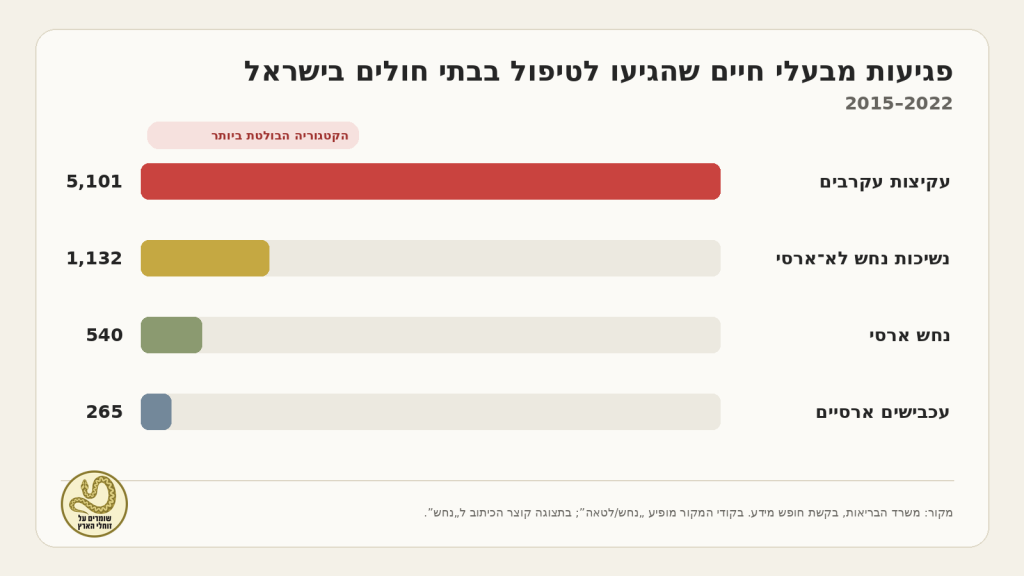
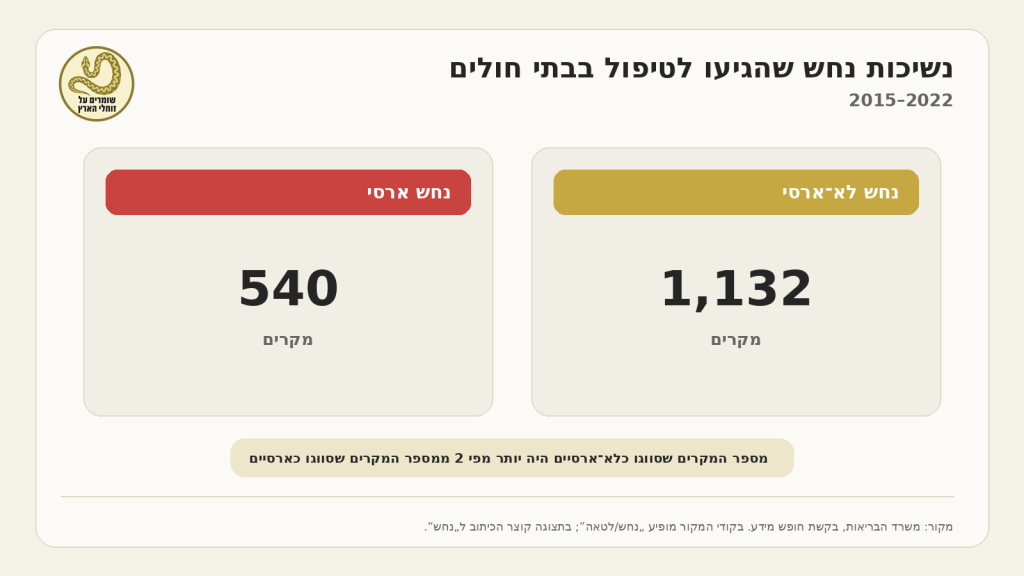
The most striking figure is the number of scorpion injuries: 5,101 cases in 2015–2022 — significantly higher than any of the other animal categories shown. For comparison, the same period recorded 1,132 cases classified as non-venomous snake bites, 540 cases classified as venomous snake bites and 265 cases related to venomous spiders. The data show that, within the detailed injury groups provided by the Ministry of Health, scorpion stings are by far the dominant category.
One of the most interesting figures is the gap between bites classified as non-venomous and cases classified as venomous. In 2015–2022, 1,132 cases were recorded in the non-venomous category, compared with 540 in the venomous category — more than twice as many. This highlights that going to hospital after an encounter with a snake does not in itself mean that the snake was venomous.
2015–2022
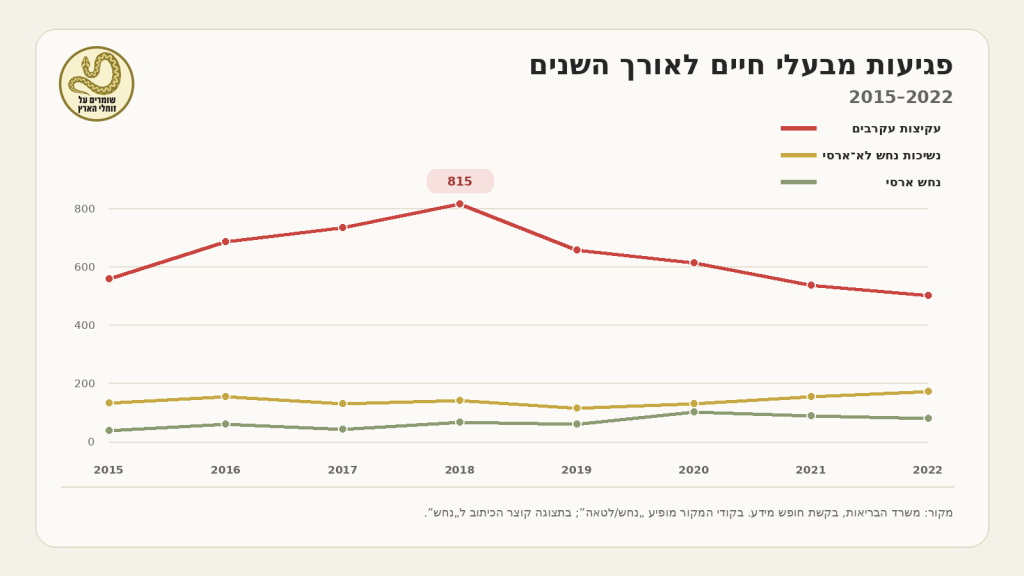
Looking at the data over the years shows that scorpion stings remained the leading category throughout the period, with a peak of 815 cases in 2018 and 501 cases in 2022. In the venomous snake category, 39 cases were recorded in 2015, rising to a peak of 102 in 2020, followed by 89 in 2021 and 81 in 2022. Non-venomous snake bites numbered 172 cases in 2022 — more than twice the number of cases classified as venomous snakebites that year.
2015–2022
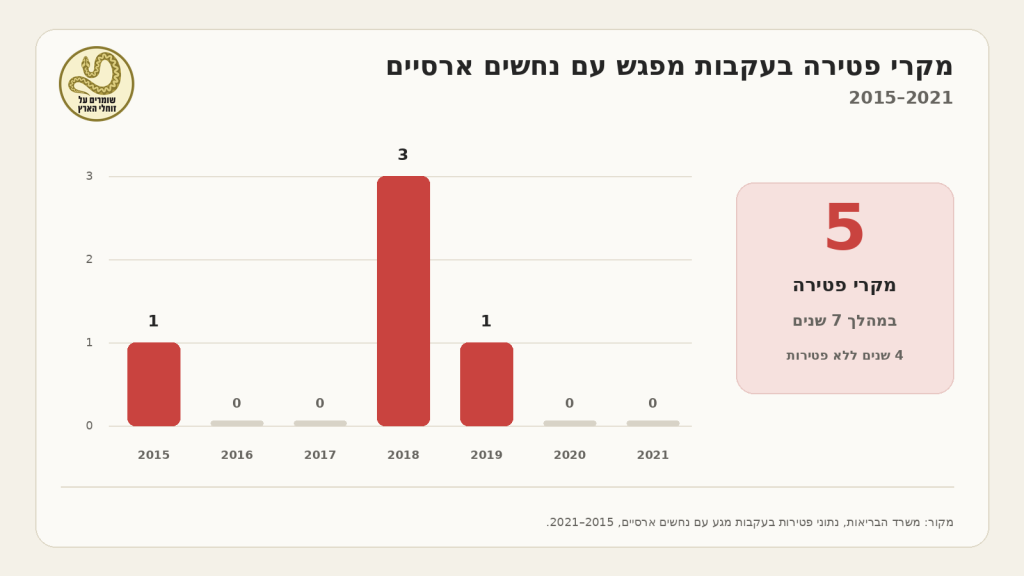
The separate table provided by the Ministry of Health lists five deaths following encounters with venomous snakes in 2015–2021: one in 2015, three in 2018 and one in 2019. In four of the seven years in the table, no deaths were recorded at all. The data show that, despite the medical risk of a venomous snakebite, documented deaths in this period were rare.
2015–2021
over 7 years
4 years with no deaths
The Ministry of Health table also includes a separate category called Toxic effect of venom (9895), in which 1,998 cases were recorded in 2015–2022. Not all cases in this category should be interpreted as venomous snakebites, and they should not be automatically added to the 540 cases classified under code E9050. This is a separate and broader medical code, so the data are presented here according to the Ministry of Health’s original classification, without attributing them to a specific animal beyond what the source allows.
Data source: Ministry of Health, data obtained through a Freedom of Information request.
The injury data refer to 2015–2022, and the death data provided refer to 2015–2021.
The data are based on records of cases treated in hospitals and on the classification codes used by the Ministry of Health. They do not necessarily represent all bites, snakebites or stings that occurred in Israel, and the frequency of species in the wild cannot be inferred from them alone.
Data processing, analysis and public presentation: Reptiles of Israel.
Data from the Veterinary Teaching Hospital of the Koret School of Veterinary Medicine, the Hebrew University of Jerusalem, Beit Dagan. Data period: May 2017 – October 2026. The first and last years are partial.
The file contains 618 diagnosis records, linked to 547 unique file numbers. A file number may appear more than once, so these figures alone cannot show how many separate snakebite events occurred.
The data were collected at one large veterinary referral center. They are not a national sample of all snakebites in animals in Israel.
Counted by month, May stands out above all other months. July and August also show high numbers of records. The chart does not yet describe unique snakebite events, because the review of repeat records has not been completed.
2017 includes data from May onward, and 2026 includes data through October only. Partial years are marked in orange and should not be compared directly with full years.
The same file number may appear in more than one year, so the yearly figures should not be added together to get the number of unique files for the whole period. A file number is not necessarily a separate snakebite event.
Seasonality: The monthly pattern highlights the importance of awareness of snakebite risk as early as spring, not only at the height of summer.
Yearly distribution: After 2018–2019, lower numbers were recorded at the institution, but this is not evidence of a nationwide decline in snakebites: referral volume, documentation practices and other factors may affect the data.
Animals: The distribution reflects the patients treated at the institution, not the relative risk of snakebite for each animal species in Israel.
Unusual species and treatment outcomes: The professional correspondence also reported bites from the painted saw-scaled viper and the desert horned viper; the exact number of events and treatment outcomes have not yet been verified. Prof. Efrat Kelmer noted that previous studies reported a mortality rate of around 10%. This is a general reference only: it was not calculated from the current file and does not necessarily describe all animals bitten in Israel.
Main conclusion: The information provides an important basis for understanding the characteristics of veterinary referrals following snakebites. It can support public education and early preparedness, but it does not make it possible to determine morbidity or mortality rates in Israel's animal population.
Acknowledgments: Prof. Itamar Aroch, for helping to direct the request to the relevant professionals; Prof. Efrat Kelmer, for providing the data and additional professional information; Dr. Sigal Klainbart, who joined the professional correspondence.
Three independent sources describe different aspects of the encounter between snakes, people and animals in Israel: snake captures, injuries to people and snakebites in animals. Combining them does not create a single measure, but it makes it possible to identify recurring patterns, point out knowledge gaps and support practical messages for education and prevention.
They are three different units of measurement, from different periods and different populations. 547 veterinary files are not necessarily 547 separate snakebite events.
In the two datasets with a monthly breakdown, May is the most prominent month: 17.6% of reported capture events, and the highest number of diagnosis records in the veterinary file. In a preliminary calculation based on the first appearance of a file in a month, May remains the leading month, but this is not yet a verified estimate of the number of snakebite events.
Capture events
Diagnosis records, not unique events
The two groups of bars use separate scales. Bar lengths should not be compared between datasets.
The Ministry of Health data highlight the difference between an encounter with a snake and a classified medical injury. Scorpion stings are an even more prominent category in the broader injury dataset.
Analysis and conclusions: Avi Zobel, founder of Reptiles of Israel
This is a descriptive seasonal match between two different sources. It is not proof of a causal link or of a national peak in snakebites.
The Palestine viper is the most reported species in the capture dataset, but capture reports are not a survey of snake populations and cannot determine its share of all snakebites. The veterinary files likewise reflect patients at one institution, not all animals bitten in Israel.
An important caveat: the Ministry of Health data received so far are partial and not ideal for a full analysis of the phenomenon. A request for more comprehensive and detailed information has been submitted, but as of November 6, 2026, it has not yet been received. In particular, the available information cannot verify a monthly peak in human snakebites. Conclusions on this subject are provisional and will be reviewed when the data arrive.
The May peak, seen in both capture reports and veterinary records, justifies moving preparedness and public education forward to the spring. This is a meaningful descriptive finding, but it does not replace complete medical data or a dedicated epidemiological study.
© All rights reserved. The analysis, processing, interpretation and conclusions presented on this page are the work of Avi Zobel, founder of Reptiles of Israel, and all rights therein are reserved to him. No part of them may be copied, reproduced, distributed, published or used commercially without prior written permission, except for brief quotation with attribution. Rights in the source data remain with the bodies that provided them.
November 6, 2026. This report is a descriptive summary, not a causal analysis or an epidemiological study.
visibility_offהשבת את ההבזקים
titleסמן כותרות
settingsצבע רקע
zoom_outזום (הקטנה)
zoom_inזום (הגדלה)
remove_circle_outlineהקטנת גופן
add_circle_outlineהגדלת גופן
spellcheckגופן קריא
brightness_highניגודיות בהירה
brightness_lowניגודיות כהה
format_underlinedהוסף קו תחתון לקישורים
font_downloadסמן קישורים
לאפס את כל האפשרויותcached
